...is soon to be leaving our 20 dollar bills ... this was cause for cheers and celebration in my classroom earlier this school year. Prior to the announcement that Harriet Tubman, a minority AND a woman - GO AMERICA! was going to be replacing Old Hickory, we had studied the Trail of Tears.
As you know, the Trail of Tears marks one of the most controversial actions during Andrew Jackson's presidency - and an unfortunate study during any Native American Cultural unit.
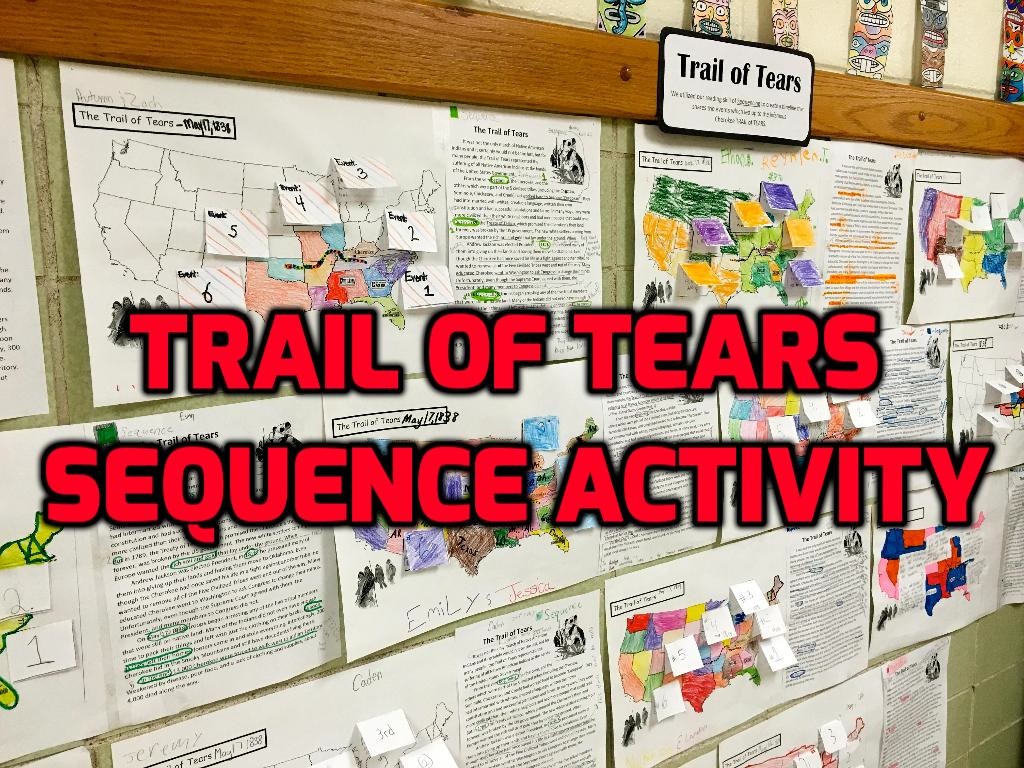
Blending both reading and social studies, I do a sequence activity summarizing the dreaded Western march of the Cherokee Indians.
Together, we do a close reading of an article on the Trail of Tears, sharing our thinking in the margins and circling key sequencing words In the beginning, next, finally.
Using this information, we number the the travel sequences (6) and students work in pairs to summarize each event on a slip of square paper. Students than recreate the journey on a map and place the sequenced events on it, in the order that they occurred.
Students gain a lot of insight during this activity and come away from the experience with a lot of knowledge and empathy for the Cherokee people.
While studying Point of View, my small enrichment reading group worked on creating stories for wordless picture books. I had previously checked out all of the wordless books we had in the library. It was fun to watch their misconceptions change through the activity. A) Most of them hadn't read the books, being higher readers, at least not in years. B) They initially felt that the activity was babyish because of the "books" and though I was crazy. C) They teased me when I said they were to "read" them, considering the books did not have any words.
After each reading one, we discussed the early elementary skill of "reading pictures" and how much thinking one actually has to do when reading a wordless book. We agreed there is a lot of drawing conclusions happening, prediction, processing what they author means by certain drawings and events etc. They grew a new appreciation for picture books, which was fun to experience.
The skill we applied was Point of View. While our standard states they must "identify" author's point of view, I had them practice the skill by applying it in writing.
Each of them chose a book, read it, then wrote the story in either first, third omniscient, third limited.
Once they completed the book, they then read another book and wrote in a new point of view. In total, each student ended up reading three wordless books and writing a first person, third limited, and third omniscient story.
They were really proud of these at the end. Our librarian shared that she would love to read some so we took them down to here and displayed them in the library next to the books.
Overall, it was good skill practice for the kids, but it also gave them a new appreciation for a genre they rarely read as higher readers.
In reading, we have been focusing heavily on Point of View (first person, second person, third person-objective, limited, omniscient). I am always trying to integrate social studies into every subject and this particular standard blends perfectly!
ELA: RL. 5.6 Describe how a narrator's or speaker's point of view influences how events are described.
Social Studies (MI): 5: 4.1 Describes the convergence of Europeans and American Indians in the Americas after 1492 from the perspective of each group.
After learning about the reading skill through our reading program, we read two different accounts on the early interactions of Cortez and the Aztec empire. Using the pronouns, students identified whether the accounts were first, second, third (objective, limited, omniscient).
If you are interested in trying this activity out with your kiddos, pick it up FOR FREE HERE!
We than did a CLOSE reading on an article that shared the misconceptions and cultural differences between the two groups. Students shared their thinking notes that they had jotted down with their table groups.
Next, they worked on creating three different points of view from either an Aztec or a Spaniard. I required them to write a minimum of two sentences per point of view. Since fifth grade really only needs to know first and third person, I added a bonus where they could practice second person and third person limited - some did!
Finally, they added their sentences to our class chart depending on who's POV they chose.
First Person POV - Spaniards
Third Person limited POV - Spaniard
Third Person Omniscient POV - Aztec and Spaniard perspective
In the end, it was really good for them to actually write in the different points of view and it really helped them be able to articulate "How a narrators point of view change how events are described." If you are interested in trying this activity out with your kiddos, pick it up FOR FREE HERE!
Our reading program focuses on author's purpose and how that can changed the tone of a story. I like to take it a bit further and talk to the kiddos about Perspective. We also touch on biased text vs. unbiased text. This can also really help kids pick out facts vs. opinions as well as Point of View (first, second, third person).
SO MANY BIRDS WITH ONE STONE!
Right now, we are studying early european exploration, beginning in 1492 with Christopher Columbus(obviously he wasn't the first... Vikings and all...)There are SO many opinions and perspectives on Columbus that this works well with analyzing perspectives. Using our reading program to catalyst the skill, we than watched three short videos sharing different perspectives on Columbus.
If you are interested in trying this activity out with your kiddos, pick it up HERE!
Students acted as movie critics and analyzed whether they were biased or unbiased toward the topic. Below are the clips I used:
It is interesting when discussing perspectives and biases how often people (kids and adults) want to call something they agree with unbiased. Even if something is true, the way in which an author shares the information can still be biased either positively or negatively. Many people in 2016 agree with the portrayal provided by video one, however, the verbiage utilized causes the video to be biased negatively because they are trying to convince you that he was not the hero we thought he was ("Here is what really happened", "unleashed terror", "he was no hero") The second film shares facts and details but removes adjectives and phrases that show us how the narrator feels about the subject. We talk a lot about why a text book writer (which unfortunately can sometimes can have biases) or the history channel would want to share only the facts and not opinions (because they want us to create our own opinions on the subject). The third film always shocks the kiddos due to its stereotypes, strange focus on skin color, exaggerations on Columbus, and of course, its complete removal of any issues between Columbus and the Natives.
What I also really like about this lesson is that it helps students see the difference between hard facts and opinions which can totally change one's perspective.
Finally, we applied our skill to literature by reading three different accounts of Columbus's journey. At this point I added the Point of View skill to our literature critic sheet.
We did a CLOSE reading on a non-fiction article from our History Alive text book. We agreed that this was unbiased. It shared some shocking information but did not share the author's opinions or use adjectives that tried to persuade the reader to think one way or another.
We then read the children's poetry book 1492. In this there are many positive adjectives and no reference to any native mistreatment.
Last, we read Jane Yolan's Encounter - such a powerful book from the 1st person perspective of a Taino Boy biased against Columbus. Such incredible description and voice in this book!
If you are interested in trying this activity out with your kiddos, pick it up HERE!
At the end, students respond to the guiding question "How can the Point of View that the author chooses change the tone of a story?
In reading, our text structure focus skill has been sequencing, so I blended this with our study of the African Slave Trade. I introduced the lesson by presenting the students with 5 picture cards illustrating events pertaining to the slave trade available HERE on my TPT. I asked them to place these events, starting in West Africa, in the order they thought each happened.
After that, I gave each pair three, more challenging, pictures to put in their line up. This activity is available HERE on my TPT. We than discussed that what we just did was called "Sequencing" and that when we read text, authors give us clue words to help us see the sequence of events. These we posted on our chart. Then we CLOSE read our texts looking for these key words and close reading to find out the different stages of the Slave Trade. You can find the text I used HERE. Note: I did not use the whole chapter, just sections 8.3, 8.5, and 8.7 to sequence the three major stages.After identifying the stages, we then underlined the key ideas for each stage making sure we get the main idea out along with important key details. We then took notes utilizing the I DO, WE DO, YOU DO** instructional format on our sequence thinking maps about the main idea of each stage. **I DO, YOU DO, WE DO method: I model how to take notes and summarize the first stage, they take notes and summarize the second stage with a partner, and finally they take notes and summarize the third stage independently.
Using our notes, I wrote a summary of the first stage (getting captured and traveling to the coast) as a model, then they wrote a paragraph summary of the second stage (traveling across the Atlantic in the "Middle Passage") with their partner, and finally, they wrote the last paragraph summary of the third stage (being sold to colonial plantation owners) on their own. Students took some time to illustrate each stage as well.
The kids did a great job of being respectful and thoughtful of this very sensitive subject and their learning showed through on their summaries. How do you teach this subject? Do you have any unique ways of helping students understand the Slave Trade, I would love to hear them!
 ...is soon to be leaving our 20 dollar bills ... this was cause for cheers and celebration in my classroom earlier this school year. Prior to the announcement that Harriet Tubman, a minority AND a woman - GO AMERICA! was going to be replacing Old Hickory, we had studied the Trail of Tears.