Showing posts with label Summary. Show all posts

Friday, February 9, 2018

WAR in the Valley

The happy colonists are enjoying their new found freedom, creating their own representative governments, harvesting cash crops, and thoroughly enjoying the NEW WORLD - however, there is trouble in paradise! We studied about the battle over the Ohio River valley between the French and the English. While fighting for control over this vital trade and farm land, we learned the cost the Natives endured. Feeling that the French respected them more, had more positive trade relations, and overall had much less settlers in the New World, most native tribes joined them in running the English out (Hence the "French and Indian War"). Unfortunately,  for both the French and the Native population, England succeeds in winning and ends the European fight for land in North America. 

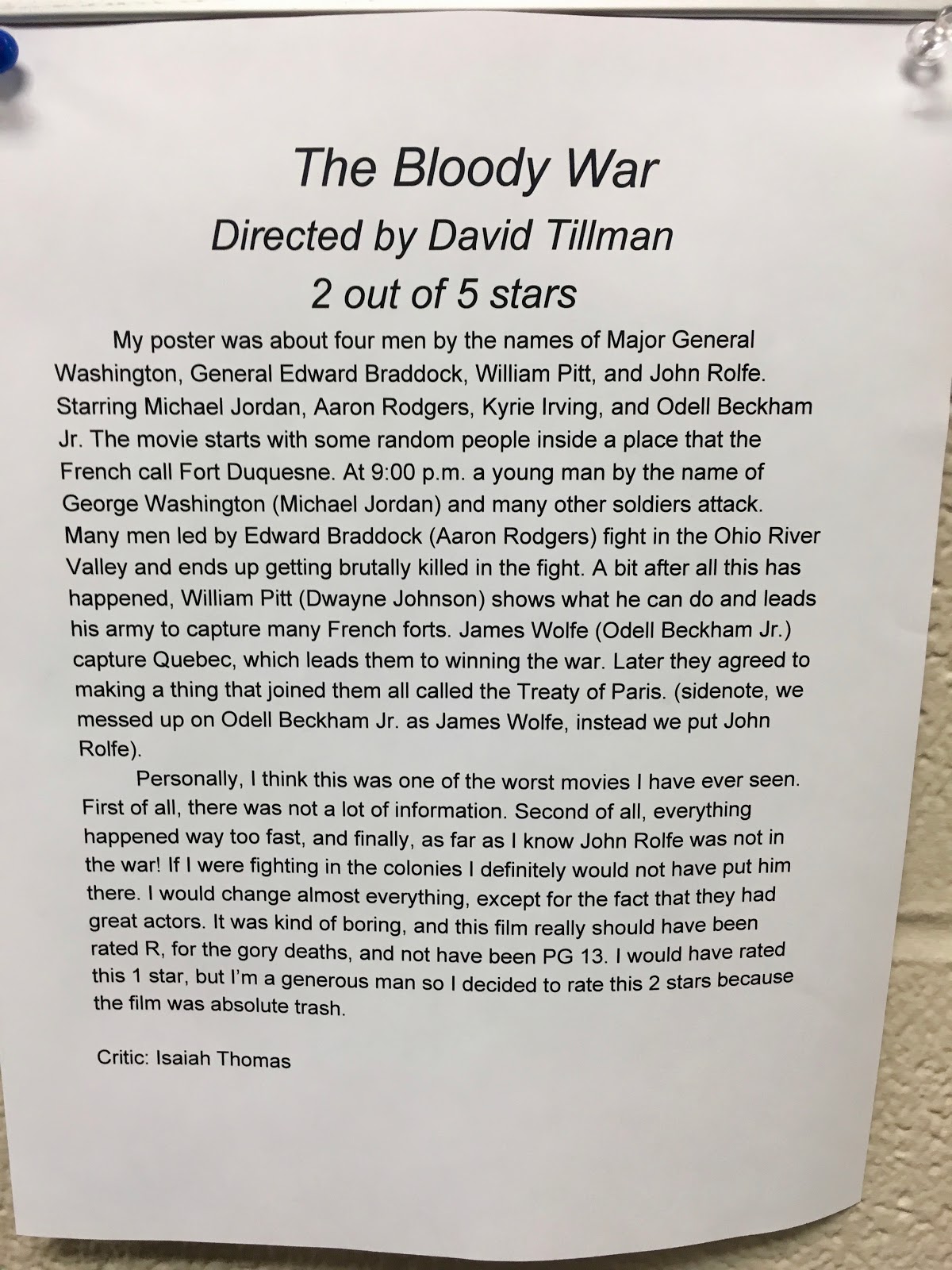
​To demonstrate their knowledge on this topic, students worked either with a partner, or independently, as "movie directors" to create a movie poster about their "War Film". Films needed to tell the story of the French and Indian War, including some of the key events and characters, but could be fudged a little in the area of creativity. Some students chose to make an iMovie trailer instead! Independently,  students also were give the task of summarizing their movie (the war) and giving a critique about their movie.


As usual, I was impressed with both the kids creativity and knowledge about the content. 

Wednesday, June 14, 2017

"If we are to have a war, let it begin here!"

The first "battle" of the Revolution occurs on a small green in the town of Lexington. In true hands-on style, we took to the "field" and had a mock paper wad battle. 

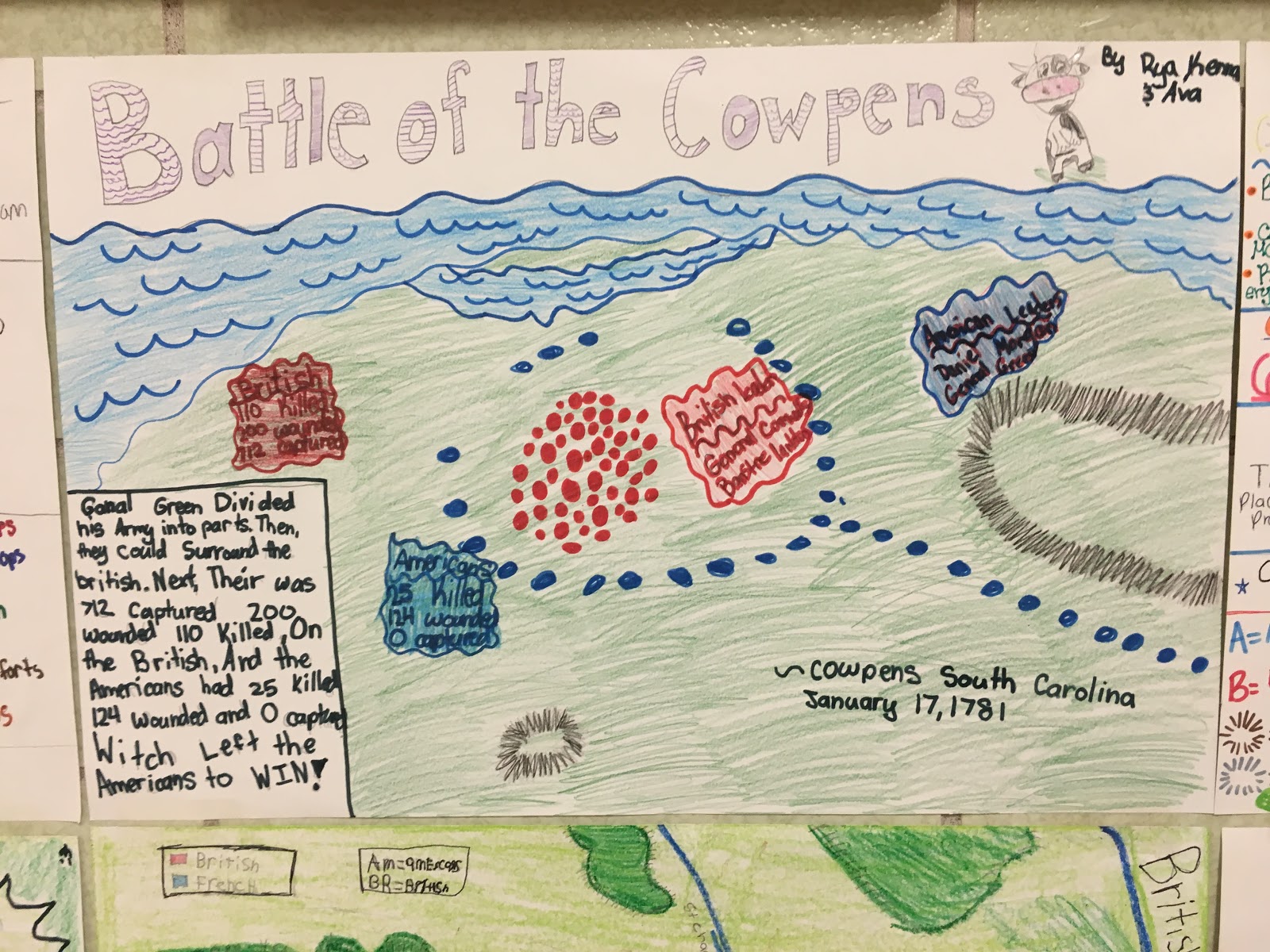
After taking a close look at the beginning skirmishes at Lexington and Concord, I had the students research the top ten most noted/important battles of the Revolution. 

Students worked with their partners to collect data on who were the leaders involved for both the British and American forces, where and when the battle occurred, the force number/casualties/captured, and the outcome of the battle.


Then students worked together to write a five sentence summary that should include who, did what, where, when, why and then 4 sentences of HOW (First, Next, Then, Finally). 

After their research and summary, the students worked in pairs to create a battle plan of their specific battle. They could make up their own or research online and find the actual battle map layout of what happened. The final battle plan needed to include their summary, the casualties/generals/prisoners for each side, and the title. 

Summary Reflection Shelves

Summarizing seems to be one the hardest skills for 5th graders to grasp or is it just my kiddos!? so I incorporate it often into social studies. In this lesson, the students work as a group or in partners to CLOSE read one of the major events that led to the Revolution (Boston Tea Party, Boston Massacre, Stamp Act, Quartering Act, Proclamation of 1763) then pull out key vocabulary words and use those words to create a summary of the event. 
Once they have established a written summary, students than create their own, independent "shelf" out of paper. 
I have them add 5 vocabulary words to one triangle (I tell them to think of words that a 3rd or 4th grader might not know because you always have those couple kiddos who "know all of these words, they aren't even hard." grrrr....ha!) 

In the second box, they illustrate the event or create a symbol to represent what they summarized. Finally, the third triangle should include their final summary. 

I really like how these turn out, and I like the independent reflection the students have to put into of the historical event. I find that it helps them remember it better. They could be used for anything - reflecting on a reading story, historical event, scientific discovery/method, etc.

Wednesday, April 8, 2015

Warmer Weather and the Walking Classroom

With the weather getting warmer here in Michigan, we are back OUTSIDE enjoying the Walking Classroom! 

 This last week, we traveled down the street to a local park and enjoyed some brisk, but VERY fresh air while learning about our nation's first president - George Washington. 
We learned the Washington had lots of important decisions to make not only as the first president, but also in his personal life, as a general for the French and Indian War as well as for the Revolution, and in creating our very new nation.
We utilized a great summary worksheet created by Stephanie at TeachinginRoom6 I swear it seems like I must stalk the woman ... okay, I might. Shamelessly. But I didn't even get this sheet from her, honestly, I got it from the Walking Classroom Newsletter. It isn't my fault she is so fabulous and everyone uses her stuff ;0) You can get a copy of the sheet HERE
 
For more information on the Walking Classroom, visit THIS post 

Monday, February 2, 2015

Longitude, Latitude, and Exploration!

Before I explain what we did and how AMAZING this project was,  I must give a MAJOR shout out to Stephanie over at Teaching in Room 6 for this incredible idea! I know that she has inspired many and I have seen this particular lesson all over pinterest, so understand that I simply utilized this awesome lesson and was awed by the learning results. 

Longitude (y axis) and latitude (x axis) are extremely similar to a coordinate grid, so this lesson works great during an Exploration unit. I did a small pre lesson on plotting points which just happens to be a fifth grade math standard! What, WHAT! before diving into our major activity. After some quick teaching, we played the classic game of battleship (which I found HERE on TPT) to help reinforce the new skill. 
 After an evening of plotting while I watched the great new history channel mini-series "Sons of Liberty" a must watch, I created my own estimated plot points for the particular Explorer's travels. These I put on individual cards and placed in envelops for partner groups. Partners then had to plot the coordinates on their blank world map, found HERE, changing the colors for each coordinate set. You can purchase the coordinate cards from my TPT HERE
The coolest part of the whole learning project was the day we matched the Explorers to their coordinates. Partners worked together to identify which Explorer matched the coordinates by reading short biographies which are available as a freebie HERE. They then matched the correct Explorer with their travel route and color. This part was FULL of independent learning discovery! Students were utilizing so many resources including maps, globes, and their own knowledge to identify and locate countries, continents, oceans, directions, and exact locations. It was definitely one of those awesome teacher moments as I watched my kiddos focused and independently learning all around me! 
Finally, students used the information from the biography cards to write non-fiction summaries of the Explorer's travels making sure to include who, what, where, when, why, and how. 
 FINAL RESULT! 
I was so impressed with their final products! This is definitely a project that I will do again! 

Here are more Explorer Activities: 
Explorers

Friday, January 16, 2015

WHY did People Explore?

I have done a lot of different activities to introduce the motives for early exploration, however, this year I really wanted to incorporate some Close reading, note taking, and summary. My theory is that if I sneak reading and writing skills into social studies I can get away with teaching it more ;0) 
 I always try to have some sort of hands-on, tangible item for the kiddos to feel, smell, use, etc. to help them stimulate their thinking. I kept those items the same which included a flag, a Bible, spices (nutmeg, cinnamon, cloves, cumin), gold pieces, and a question mark.
This time though, I added different informational paragraphs that I found here and there that share the reasons for exploration. With a partner, the kids shared the packet of articles and used the clue item at their table to figure out which motive it matched. For example: the flag represented lands to conquer. Spices represented their desire to acquire spices and other trade items from Asia. A Bible represented the push to spread Christianity. The gold pieces represented the quest for gold and riches. Finally, I couldn't really think of an object for "adventure" so I just had a question mark - it worked :) 
Once partners had identified their object and its importance to the reason for Exploration, they then had to work on highlighting key words that answered summary questions including who, what, where, when, why, and how. These five words also were to show their evidence on why they matched their item to that reason. 
I was so impressed with how engaged and focused they all were! It definitely helped instill the 5 reasons as well as give great practice at summary, note taking, partner agreement, and reading fluency/comprehension of more challenging text. 


Here are more Explorer Activities: 
Explorers
Related Posts Plugin for WordPress, Blogger...