Showing posts with label Colonial America. Show all posts

Friday, February 9, 2018

Out with the old...WAIT.

So, as many of you know, I moved this year from being a 5th grade English and History (humanities) teacher to be being an 8th grade English and History teacher. I was excited because I LOVE teaching American history, and both 5th and 8th study it! As I was forming lesson plans early on, I was very much afraid that the activities I did with 5th graders would be too juvenile for 8th grade. 
Boy, was I WRONG. 
If my 5th graders loved it, my 8th graders love it. 
annnnnnd the exciting part is the level of depth my middl schoolers are then able to take the information. 
Here are a couple cross over activities that I have previously posted about. 

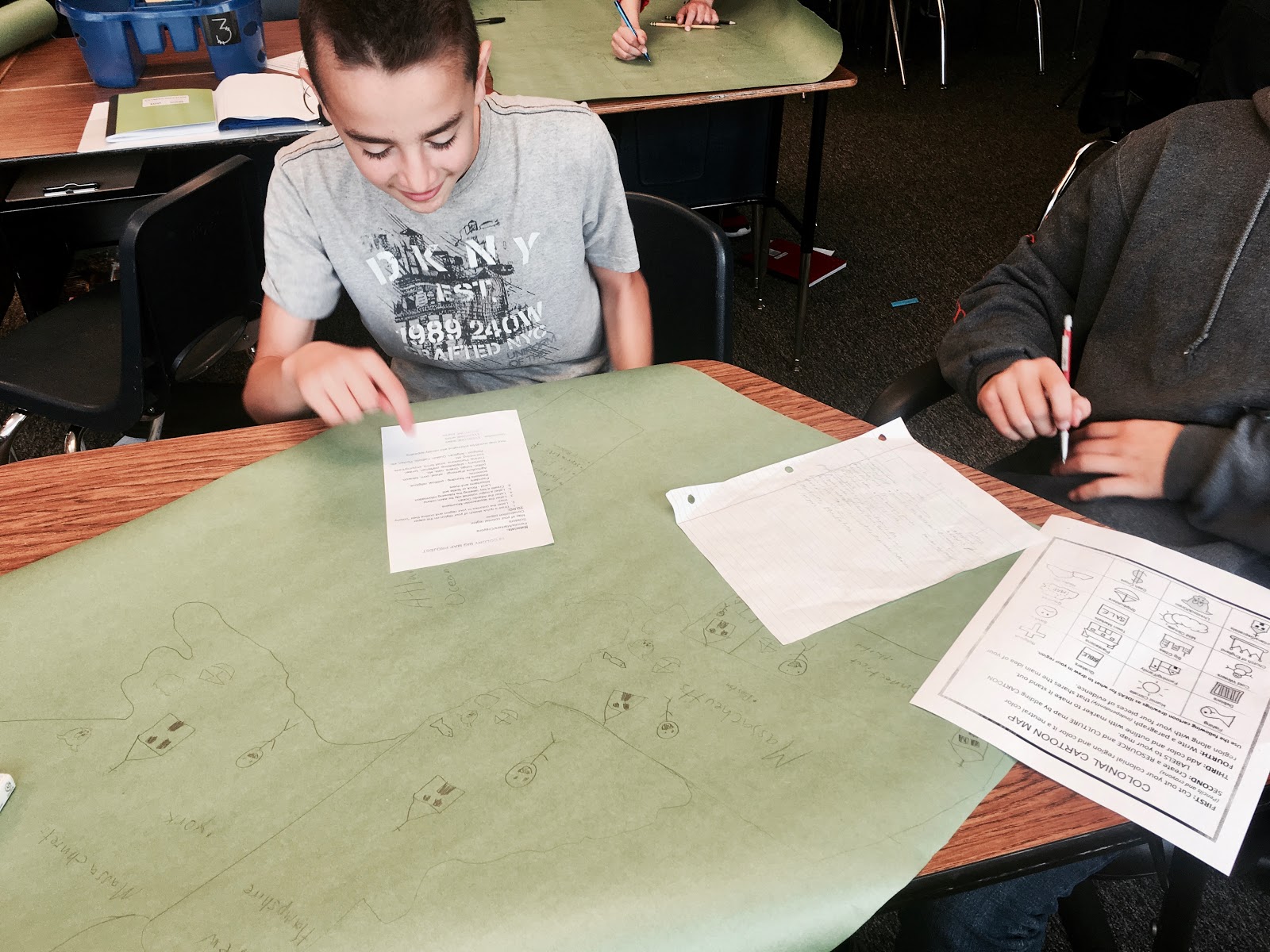
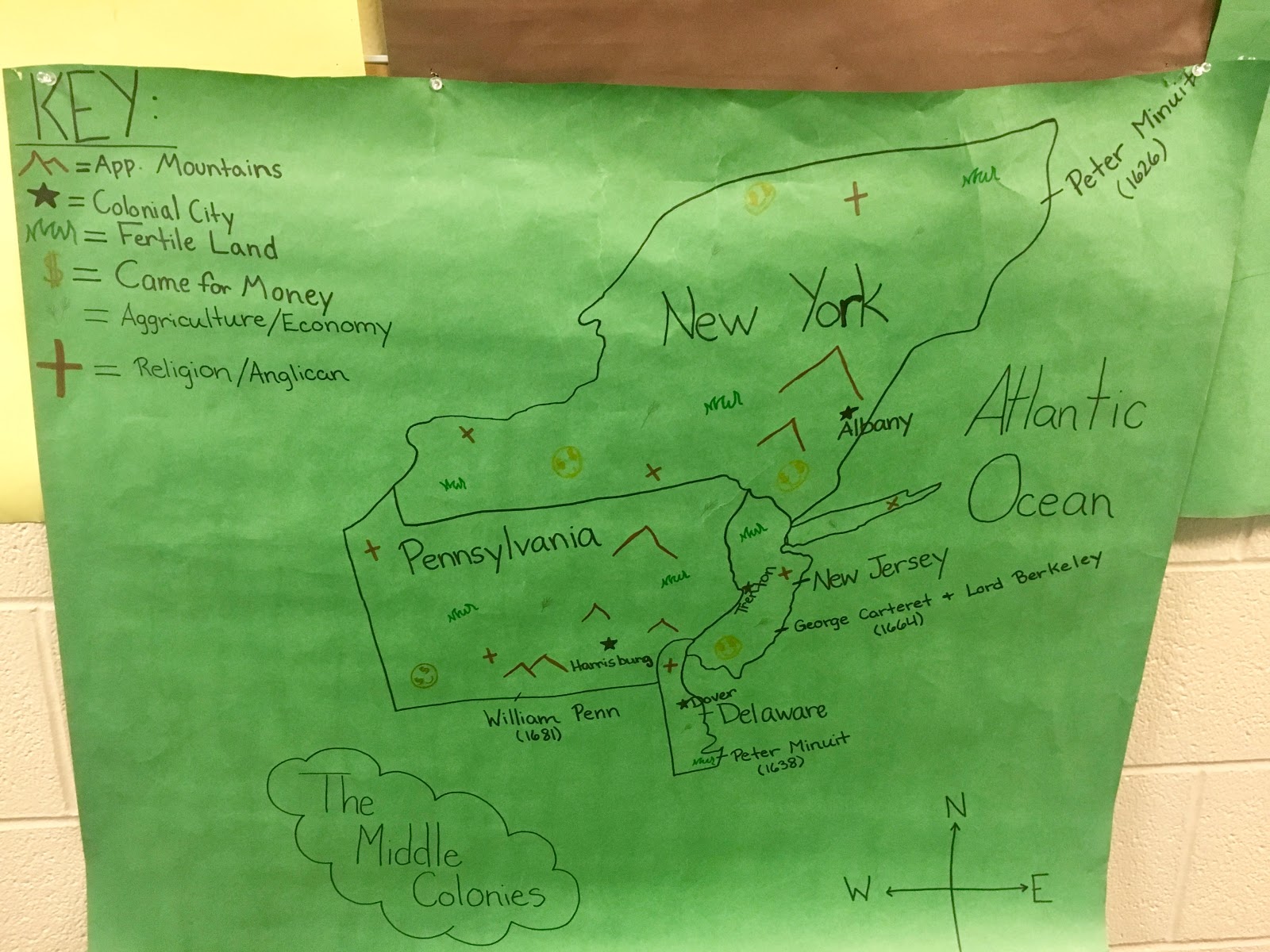
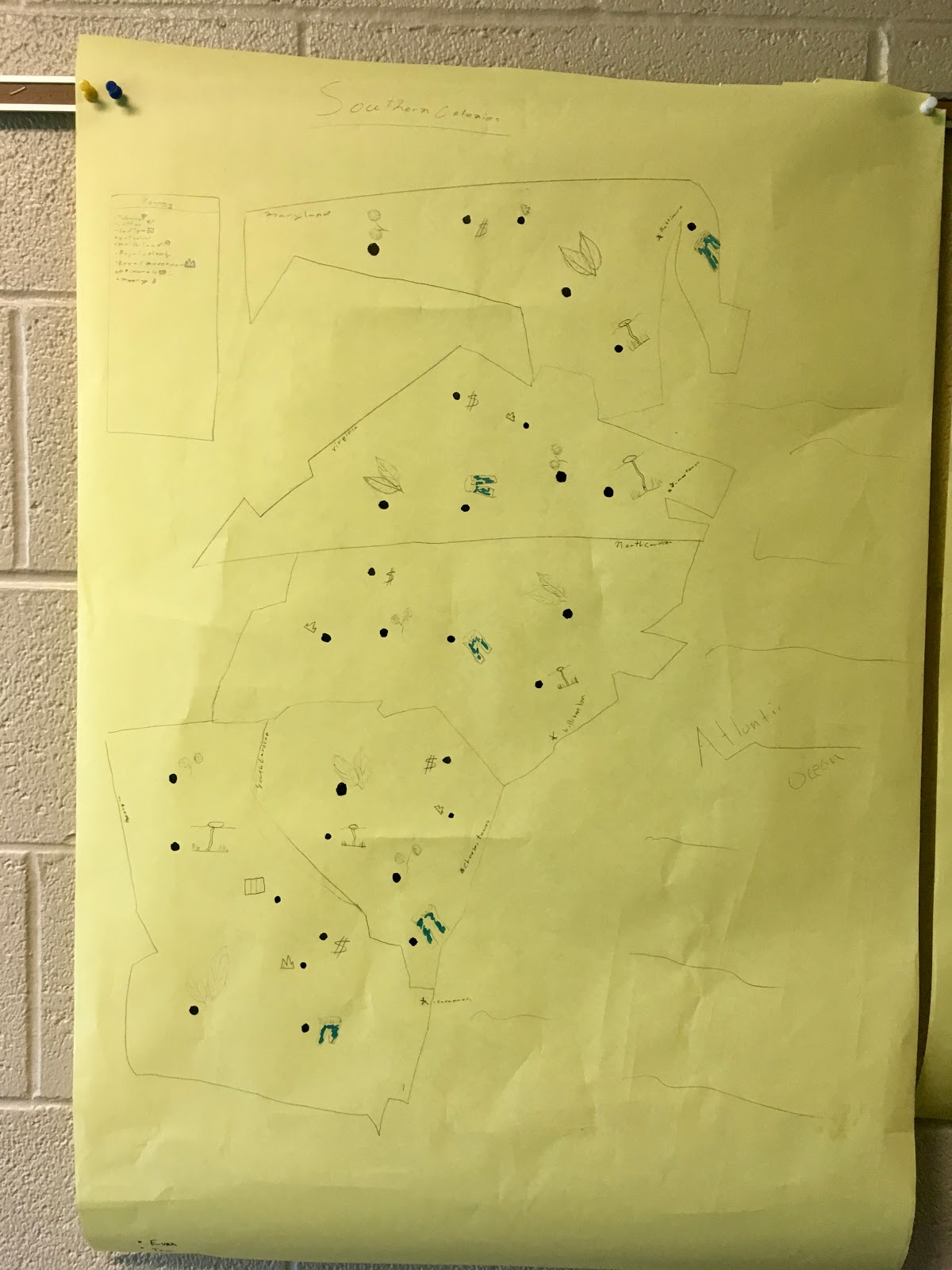
Colony Resource MapsWe studied the different regions, identifying their different governments, environments, religions, economies, and reasons for founding. 
After completing our "moving textbook" notes, where students filled in their tree notes while reading printouts around the classroom, students worked with a partner to create a resource map and key for a specific region. 


 Playing with Gummy Bears: Food is always a crowd pleaser no matter the age. After studying the Revolution, during our Government unit, I busted out my gummy bear types of government lesson. A classic. 

Sunday, July 10, 2016

Introducing Colonial America

After our unit on early English settlements, I introduce the colonies through a Picture Comparison Walk. 
If you are interested in these pictures, you can download them for free at my TPT site. 
I print the comparisons of houses (interior/exterior), clothing, soldiers/militia, and other aspects of colonial vs. early settlement life and place them on large construction paper. Then the kids rotate around the room with their table groups, jotting down their thinking. Students do not talk during this activity, although, they can communicate through writing on the construction paper concerning someone else's thinking. 
 Nothing compares to a classroom of independently focused students *teacher heart happy*
 What I really like about this activity is that the students are able to make connections between the 1600 and 1700s on their own. For example, instead of saying to them, "life improved for the settlers as more and more people came and they began to make bigger cities, import more goods, and create a stronger economy." Students are able to see that for themselves. Their thinking demonstrates this when they say things like: 
I see that they have nicer clothes, more frills, etc. 
The girls still wear dresses, but they are made out of a nicer material. 
Their houses are made out of brick instead of wood and mud. 
Soldiers have uniforms. 
etc. 
I also really like that these pictures can be hung up and utilized throughout the unit for students to refer to, particularly when they are drawing pictures of colonial life.  

Thursday, July 7, 2016

Candle Dipping an Colonial Research

Warning: Photos galore!!
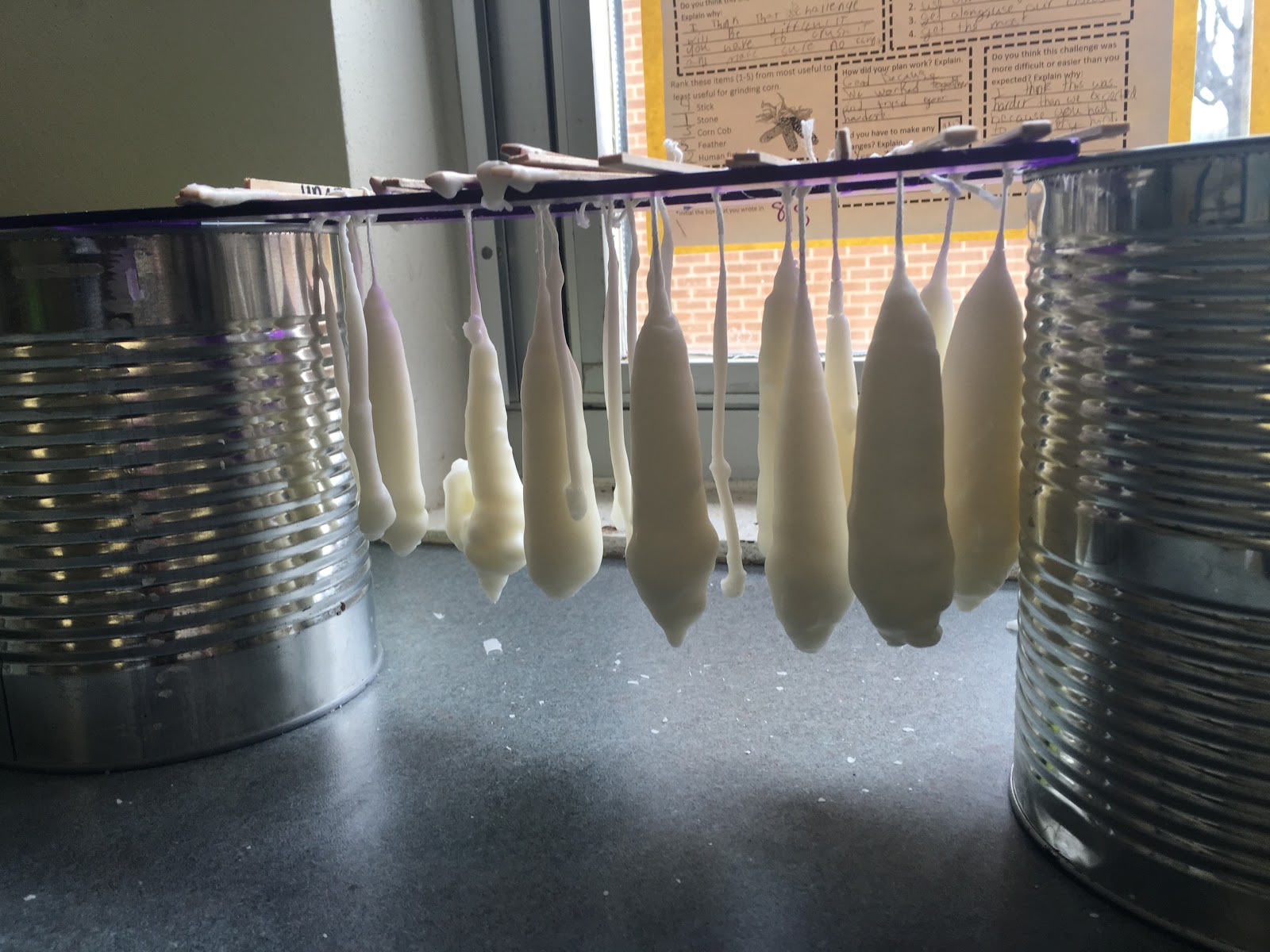
I feel candle dipping is a colonial unit "must". I can still remember doing it on one of our historical field trips in the 4th grade. However, I have always struggled with the time management of it and educational justification. 
One container of wax to dip into + 53 students = TONS of wasted instructional time and a bit of A MESS!
Therefore, it has sadly never been done in my classroom. 
Until ... THIS YEAR!! 
SOLUTION: Get them working on their colonial research projects with a partner and pull them up to dip candles one group at a time. GENIUS.
What you will need: 
Candle Wick roll 
Wooden sticks 
Candle Wax (10 lb)
*Found all supplies at Michaels and was able to use my teacher discount - WIN! 
Hot plate or Old Crock Pot 
Container of Water

It was awesome, people! Not only did they really enjoy the activity, but it helped make the research process more enjoyable, since they had something to look forward to as they were working. Definitely an activity I will do with them again!
Research - Dip - Research - Dip - Research - Dip 
Our candle growth progress 
1
2
3
They were so stinkin proud of their candles - finished product
 And their colonial research papers turned out great as well! 
Grant it - these took a few more days than the candles ;)
 We also created resource maps of each colonial region.  


Colonial Village Simulation

I. Love. Character Simulations!!! 
I remember falling in love with the idea of simulations when I visited the Holocaust Museum and the Titanic Museum. At each, visitors are given a card with a real characters name and a mini biography about their life. They are written in the second person sharing what "Your" life was like. According to the Holocaust site, these are meant to "help personalize the historical events of the time" which I truly believe they do! While the content of each museum was humbling and heart breaking, the character simulation enhanced the experience so much that I knew, as a teacher, I would incorporate them as much as possible in my classroom!

So, during my colonial unit, I created character cards, similar to my Renaissance character cards that I share in THIS post. I decided to change things up a bit, however, and have them be more interactive. I created them so different characters "pair up". This does makes passing the cards out a bit trickier, since you have to make sure you have the right number of characters and that those characters all match up to someone else in the classroom - but it is a LOT of fun! If you don't have an even group of kiddos, join in the fun yourself! 


Once students receive their card and read their brief bio - they are to act out the final underlined action. Some of the actions require people to find someone performing an occupation, others require the student to simply stay put and act out their occupation. I always tell the kids that props are optional to help aid their character but that they have 10 seconds to "get into position".
For example: 
"... you are in need of some shoes for your youngest son, Timothy. Find the Shoemaker.

"... Better get back to work, those shoes aren't going to make themselves!" 

 My kiddos have such a fun time meandering through out the room greeting and searching for their pair. 
We did this in ultra low lighting and the pictures turned out pretty bad so I went with sepia for effect :) 
When greeting each other, students are required to introduce themselves, ask the other person their name and profession, and shake hands. If they are not their match, they are to say, "It was very nice to meet you" and move on. 
This young man is performing his occupation of ship captain by acting out the use of his scope.  
 This girl was a servant so she quickly grabbed one of our brooms to help aid her occupation.  
This girl's character was pregnant and looking for a midwife - notice her sweatshirt under her shirt *bahaha*
 The other girl was the wife of the tavern owner in town so she jumped up and stood under our colonial tavern set up. 
Afterward, students share their character with the class. A couple of my kids give  their best British accent a try when sharing about themselves. *grin* 
If you are interested in my Colonial Character cards, they are available HERE on my TPT site. 

Tuesday, June 7, 2016

Jimmy Cracked Corn

During our Early Settlements unit, the kids found all the different jobs that children had to do fascinating. Early on, students comments center around the children being over worked ..."treated like slaves, being worked too hard by their parents, the Cinderella story," etc ... However, as we dive deeper in to our study, I am always happy to discover the change in my student's understanding what up, Synthesizing!! :P
One important lesson that really helps drive this understanding home is a reading inference lesson on Sarah Morten's Day. I am sure many of your are familiar with this book, being a teacher favorite around Thanksgiving. 
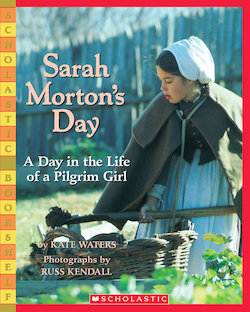
I start the lesson by reading the story as a good old fashioned read aloud. By this time, students have a pretty good understanding of Jamestown and Plymouth so they can make some good connections to the text. 
I then work through the inference sheet I have created modeling my thinking with the first text inference, the second two they complete by sharing their thinking with their partner and than writing down, the last two should be accomplished individually, however, you may need to model more if this is a new skill. 
At the end, students have an opportunity to share their reflection on what life was like for children during early settlements. After diving deeper into the text's meaning, students can form a more accurate assessment of childhood. 
Student Observations: 
  • They probably had to work harder because if they didn't their family might struggle for food during the winter. 
  • Everyone had to help out to help the family survive - pull their own weight.
  • They were very respectful of adults and their parents.
  • They enjoyed games like we do.
  • Parents had to be strict because life was harder and they were focused on survival.
  • Parents loved their children and children loved their parents, just like today.
As a fun sponge activity, we also practiced grinding corn. I had the students fill out a planning sheet before our activity which can be found at my TPT store. They REALLY enjoyed this activity. 
Materials Needed: 
Planning/Reflection sheet for each group
24 medium sized rocks 
One 10lb bag of squirrel corn (whole cob) 
Container to carry corn and corn meal 

Students had a great time pounding corn - many of them were surprised at how long it took to get down to corn meal. They also discovered many different methods that helped the process, such as grinding the kernels with the rock instead of slamming the rock down, keeping the kernels together to crush instead of spreading them out, etc. 

Overall, I think this activity, along with the inference lesson, really helped the kids recognized the importance of children's work in early settlements and the manual labor it took. 
Related Posts Plugin for WordPress, Blogger...