Tuesday, March 4, 2014

THINKING and TALKING about our Reading

This past week we have been focusing on THINKING about our reading. Utilizing lessons from Comprehension Toolkit and other wonderful resources on the internet including amazing notebook inserts from The Pinspired Teacher.
A big thing that the toolkit talks about is listening to your Inner Reader Voice. The kids are really getting good this and we have slowly begun the transition from thinking about our reading mentally to jotting our thinking down so that we can share.
 Students read and jotted down their thinking independently then shared together with the class. This is called READ. WRITE. TALK.
This week, we reviewed our thinking jots and why readers take time to write notes down to themselves. Then, we discussed what Purposeful Talk was. We have already done a few mini-lessons that break down a lot of these things like, SLANT (sit up, lean forward, act interested, nod for understanding, track the speaker), listening with intent, saying something meaningful/keeping the lines of thinking alive, so today was more a combination of all these things. 
I first gave a small description for each article they could choose to read. Then, students read the articles independently, jotting down their reactions, connections, and questions for the READ. THINK. part.
Once we were finished I had the kids reflect on one thing they learned (Content Response) and how talking with their group helped their understanding of the text (Process Response). THIS really helped me see how much they understood about the lesson and how they felt about the activity. Apparently, they got a lot out of it and like it! *happy dance*  
In other news, check out this kiddos killer shirt! If you were looking for Brownie Points buddy - you FOUND  them! ;0) 

Saturday, March 1, 2014

Coordinating Grid ELA/SS Integration

So, I know, I do not teach math. However, my partner teacher did some thing so fun with the kids that I just HAD to share! During their unit on coordinating grids, she discovered a website through Teaching in Room 6's blog, called WorksheetWorks.com, that allows you to write in any phrase, it will plot out the coordinates for it, and the kids can find them. A-MAZING!
The potential for this is limitless, one could do math with literature quotes during a lit. group, put in famous quotes from famous historical characters (brains already churning about my Revolutionary War unit!), I mean, there are so many cool things that can be done with this resource to integrate math into other areas.
She had them do half of the quote, then find their partner to complete the phrase - fun way to have the kids infer what the other half of their quote was. We have a really artistic group this year, so she also had them draw a poster picture to go with their quote. Here are a couple that I snagged a picture of before they were taken home, sad that I missed most of them!
NOTE: We were very unaware of the missing H in CHUM bucket on this lovely poster until AFTER it was sent home and I was putting this picture up on the blog. .. my husband said that this was definitely worthy of "Kids say the Darndest Things" or CHIVE baha! oops. 

In other news, we wrapped up the Winter Olympics 2014 in Sochi as a school last week with a special "Dress like an Olympian" Day. We have also been celebrating the games through our reading groups :)

Narrative Writing Unit

We are just wrapping up our Narrative Writing Unit which we have been diligently working on for the past three weeks or so (give or take a million snow days!). Our stories are all centered around the conflict of a character getting "stuck" in a snow globe - appropriate I would say since that is a lot like how we have all been feeling recently :0) I do this particular unit as a "packet" that stays in student's writing folders. 
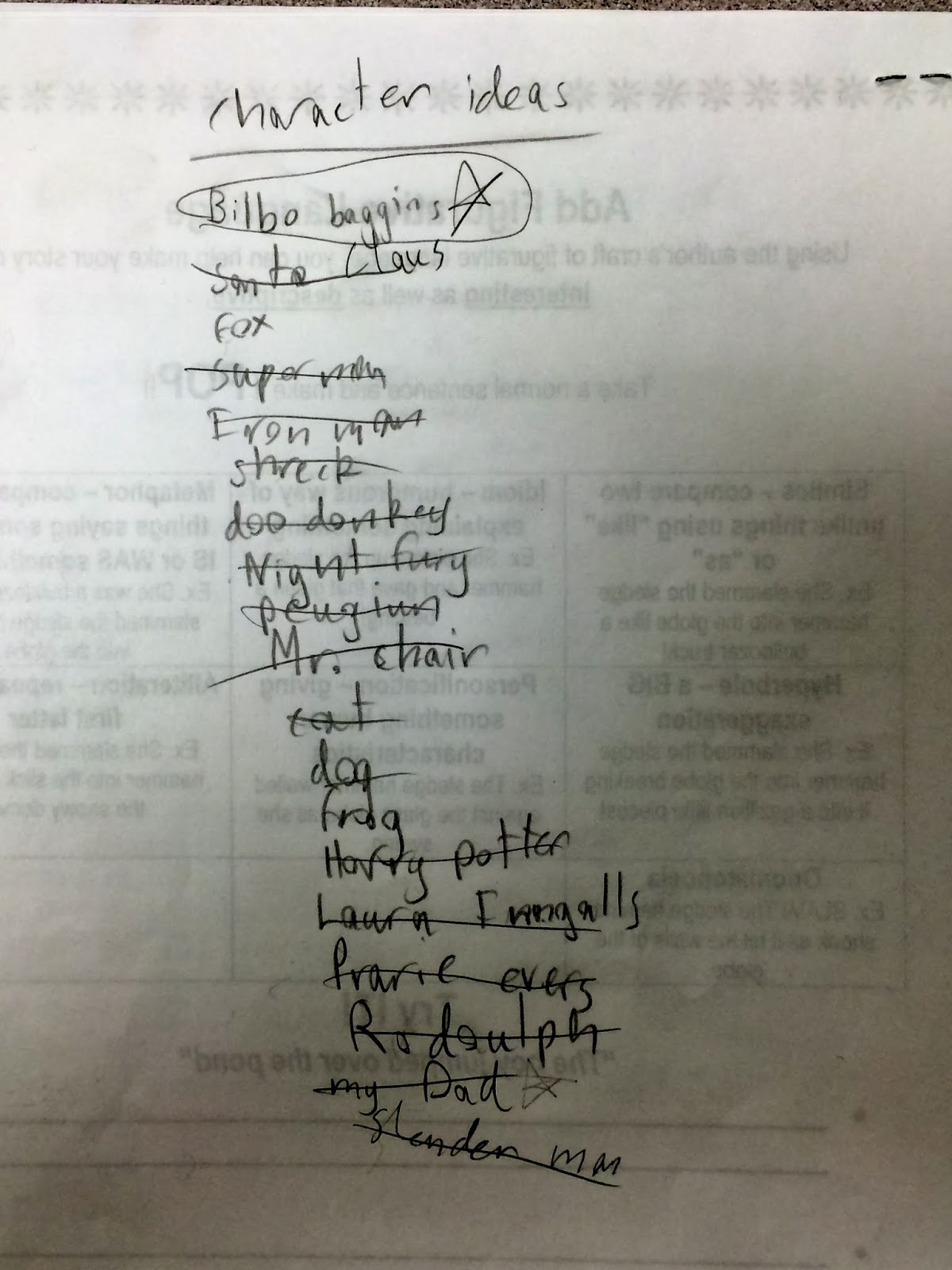
First, we created our characters and made their descriptions. The character could be made up or taken from a popular book series, movie, video game, actor/actress, TV star, holiday character, historical figure, etc. They then had the choice of either keeping the characters personality the same as the original author intended, or changing it to fit their story.
Picture

Next, we focused on our setting description by reading good settings and noticing how the authors SHOWED and did not TELL what the setting was. We noticed that they used lots of descriptive words, similes and metaphors, ACTION, and the five senses to convey a picture in the reader's head. We created our own five senses descriptions of our snow globe settings and then used these to create a setting paragraph to insert into our narratives.
We brainstormed different ways our character got "stuck" in the snow globe - this constitutes our major conflict in our story. The next important part of the story was to outline how the character tries to get out - how that fails, how they try, how that fails ... etc. This will be the biggest part of our story (rising action), most commonly known as the PLOTWe have outlined what will eventually work to get our character out! (climax, falling action, and resolution). We also focused on what our character will learn, since as good author's, we will have a purpose for our story and a message (or theme) for our reader to learn. 
We have identified what I like to call pop corn dialogue (dialogue that pops back and forth between characters that does not share description, action, feelings, or thoughts) and mixed dialogue (dialogue that is a good blend of both talking and description, action, feelings, and thoughts)After analyzing good and bad examples, we practiced writing our own pop corn and mixed to add to our narratives. 
My example is sad, I know, but I had a friend pass away this weekend and the students and I had just had a wonderful discussion about death and how often, writers write about things close to their heart - the result was this in my dialogue ... 

We are working independently on the actual rough draft of our stories as we continue to add the different components of a narrative after each mini lesson. The students keep track of where they are at in the writing process as we move along - as you can see, most of us are working on our rough drafts. And of course, they reread by ear-muffing their stories (whisper read to themselves with their hands over their ears) every day to remind themselves of where they are and what tense they are in. 

Since these are narratives, we knew that our characters needed to learn some sort of lesson, either humorous or serious that our reader could take away (the MESSAGE) see THIS lesson for how we looked at the author's message/theme. We looked at real examples and created three of our own using sentence stem starters. Students could combine, use word for word, or create their own. Once they had tried three, they chose the BEST one (after sharing and discussing with partners) and added this to their rough draft. 
This week, we are working on creating a really powerful HOOK. Check out THIS POST to see all the fun thing we do to practice HOOKING our readers! 

Friday, February 28, 2014

Valentine's Ball {Formal Dance}

I know it is a little late (oops!) but we had too much fun for me not to share a little of our celebration!
It was a wonderful mixture of pleasant awkward - as Valentine's always and forever will be in elementary school :) 
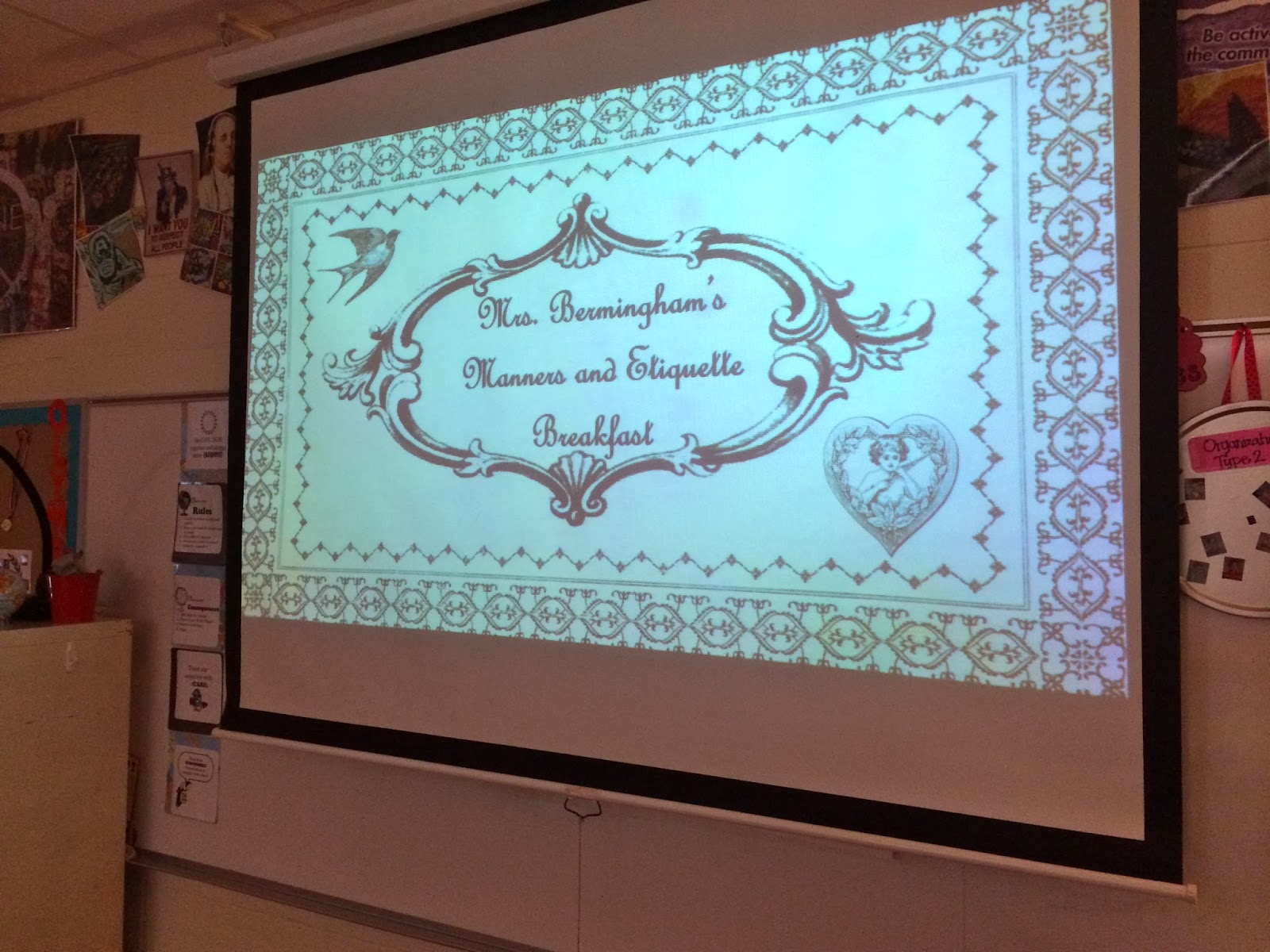
The day began with our annual Manners Breakfast starting with a lesson in Chivalry (a sadly, quickly disappearing trait), where it came from (tough, gory, medieval knights) and how ladies should react. We learned together when to place our napkin on our laps and 
what to eat/not eat with a fork during formal dinners. How to set a simple table setting, how to interact with waiters/waitresses, and how to interact with table guests and/or host/hostess. 
The room pre-kiddos
Students were asked to dress in their "finest" for our festivities! 
Then, donning aprons, our own waiters and waitresses served us our wonderful breakfast of muffins, orange juice/milk, yogurt, and fresh fruit. 
For our reflection, we completed our vintage place mats by sharing 5 things we learned from the etiquette lesson. 
For the second part of the day, we learned a combination of six dances - three with myself including SWING, WALZ, and SALSA. With my partner teacher, DISCO, the TANGO, and the CHARLESTON. Learning them with the opposite gender made for many awkward, yet rewarding, experiences as students learned how to respectfully interact with each other on a dance floor.
At the end of our practice, we learned the history of formal dances (Balls) and the practice of "Dance Cards" used by girls to organize their evenings. Each of the girls in the room were then given a dance card with the predetermined TWO dances they would be required to have a male partner for (SWING and WALZ). The ladies then walked around the room and responded to the requests of the gentlemen's "May I have the Walz/Swing?" (of course the only response could be yes, unless your card was full). It was adorable. It was awkward. It was a wonderful barrier breaker. 
The look on this guy's face says it ALL! *tehe* 
After lunch, we "got dancy!" Rockin to all styles of music, the kids really showed off their moves :) The first formal ballroom dance we had was Swing, the kiddos partnered off and did a great job of practicing their previously learned moves. Many of my students this year (more then I have ever had in the past!) stayed paired off and definitely blew me away with their skills! The second ballroom dance was the Waltz - these, mixed with inserted group dances, created a very FUN dance party!  
A delightful surprise by one of my girls, and quite possibly one of the coolest things I have had a kid do, was share her dancing, which left many of us in awe! 
(The video is not working right now sadly!)
 Cookies and punch were shared during our dance intermission, Valentine's were passed out, and boxes were admired. Below is a sneak peak at a few of the finest boxes I've ever seen come out of my room! 
and yes, my favorite, a snowboard box from the 2014 Winter Olympic games! 
Sweet Valentine's Treats from my kiddos! Love them! 
MY LIFE: 
Goofing off with MY Valentine - MR. B
LOVE THIS MAN <3
Also was blessed to be able to drive down to Tennessee (and SPRING!) to visit my favorite little sister! The Lord is GOOD!  
I hope you were all richly blessed by the one's you love! 

Tuesday, February 18, 2014

THEMEssage

Theme = the message of a story
A common, but effective, way to remember that THEME is the MESSAGE the author is trying to convey.
We have been reviewing and working on theme this last week.
In our thoughtful logs, we added some great inserts that I TPTed (wonder when this phrase will be added to the dictionary??) from The Pinspired Teacher. They are a great reminder that theme can be either stated or implied in a story. The little books did take quite a while to put together but they turned out so cute that it was worth it!
We have been working on figuring out different themes in our read alouds, independent reading, and in the world all around us (INSERT WALT DISNEY CONNECTIONS! *squeal*)
Theme can often be a confusing and complicated concept for students so I also tried to utilize what I now call the "Tanny Effect" by taking a more abstract concept and making it clearer in a kinesthetic/real world sort of way. If you are not using Tanny McGregor's book "Comprehension Connections" you are MISSING OUT! I know I have talked about this a lot, you can actually see an entire post devoted to her style HERE, but honestly, her methods are just that good! Okay, off my soap box. .. ..
Using music is one of her ways of breaking down a more abstract concept, so I gave it a try with THEME. We listened to some common older and newer songs that had STATED (obvious - usually stated clearly in the chorus) and IMPLIED (much harder to find, clues are discovered in the verses).
Songs:
  • Man in the Mirror - Michael Jackson (To make the world a better place, change your self for the better) 
  • Ain't No Mountain High Enough - Marvin Gaye (Don't give up on love) 
  • Time of Your Life - Green Day (Hold onto the good times/memories) 
  • Stronger - Kelly Clarkson (Learn from your mistakes - I love the kiddo belows definition!) 
  • Handlebars - Flobot (note: this song has some vocabulary you will want to discuss with students before listening including missal, holocaust, vaccinations - definitely for upper el/middle school listeners) 
    • This song has a powerful message that grows alongside the music - example of author's craft in music usage
    • You have the potential to do what ever you want, GOOD... OR BAD - it is YOUR choice! Especially powerful for children since their life is still all before them (love the connection to the riding of a bike ... basically, the song starts and ends with a child) 
We also have been working on looking at narratives and how the authors give us clues, just like in the music, which are both implied and stated that point toward the overall theme. 
Finally, for a smile before you leave, here is a very impromptu video that I grabbed as the lesson was occurring. 
ATTENTION: there is a ROCK STAR in my classroom ;0) 

Crunching and Munching on Multi-syllabic Words!

Recently, we have been working on using strategies to help us decode unknown and unfamiliar words. 
As we all know, decoding word sound involves lots of different things: 
  • Understanding letter sounds (phonics, letter a, b, c,)
  • Flipping sounds between their short and long vowel sounds 
  • Understanding letter sound combinations (-tion, ch, -er, ious, ism) 
  • Blending different sounds together 
  • Recognizing grade level sight words that do not match rules - you know, like Colonel and Kernel (gotta love the English language!)
By fifth grade, many students have most of these skills, however, some of our kids still need the extra support, and ALL of them need to recognize that we use these strategies everyday (usually without thinking about it) when we encounter a word that we don't know how to pronounce. 
Picture
Today, we looked at a concept I found HERE on pinterest called CRUNCH and MUNCH. In this simple, but awesome strategy, kids CRUNCH the word into syllables (paying close attention to Greek and Latin suffixes and prefixes) and then combine them to sound out the word.
The kids did a really good job of breaking down difficult words using this strategy. It was really fun to see them freak out when I placed a LONG word on the board and then watch the excitement/light bulbs go off once they realized they now had a tool to break it down and sound it out. Then they began asking for BIGGER words - this challenged me! hehe  
As always, we had a notebook insert that matched my anchor chart (please ignore my sloppy handwriting! Gotta love the GIANT "C" in echolocation - ha!), I modeled this strategy using a word from a read aloud, then we practiced it together using a couple words from our morning fluency read. Lastly, I had them look for unknown words during their independent reading that they could CRUNCH and MUNCH to decode. I cannot make this insert available since it so closely resembles the Lesson Clouds which she has on TPT. 
In small group, we practiced more of this reading a short article. I was AMAZED at how much easier it was for my kids to CRUNCH up the word parts now that I am incorporating more Greek and Latin root words into our curriculum. So many of the parts in multi-syllabic words have them and it makes it SO easy to remind students to A) look for these and B) remind them not to crunch them, and other common word parts, apart when breaking down the sounds. 
If you are looking for a FUN, easy, and effective way to incorporate Greek and Latin suffixes and prefixes into your curriculum, I HIGHLY recommend The Reading Olympians. I am hoping to do a post on it and how I use it in my room in a few days.
What are some of your favorite tricks for helping kids decode unfamiliar words? 
Related Posts Plugin for WordPress, Blogger...