Thursday, July 7, 2016

Candle Dipping an Colonial Research

Warning: Photos galore!!
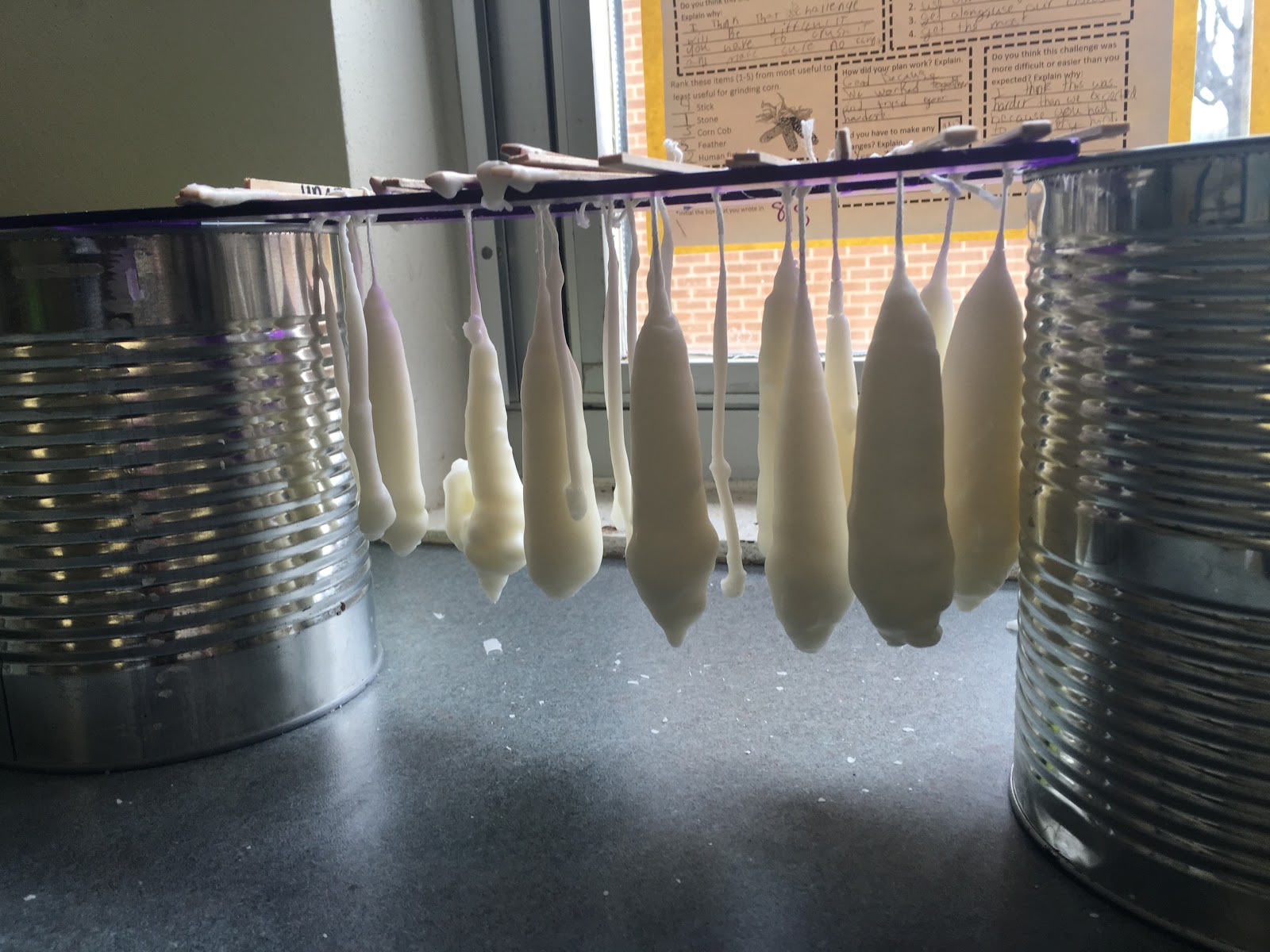
I feel candle dipping is a colonial unit "must". I can still remember doing it on one of our historical field trips in the 4th grade. However, I have always struggled with the time management of it and educational justification. 
One container of wax to dip into + 53 students = TONS of wasted instructional time and a bit of A MESS!
Therefore, it has sadly never been done in my classroom. 
Until ... THIS YEAR!! 
SOLUTION: Get them working on their colonial research projects with a partner and pull them up to dip candles one group at a time. GENIUS.
What you will need: 
Candle Wick roll 
Wooden sticks 
Candle Wax (10 lb)
*Found all supplies at Michaels and was able to use my teacher discount - WIN! 
Hot plate or Old Crock Pot 
Container of Water

It was awesome, people! Not only did they really enjoy the activity, but it helped make the research process more enjoyable, since they had something to look forward to as they were working. Definitely an activity I will do with them again!
Research - Dip - Research - Dip - Research - Dip 
Our candle growth progress 
1
2
3
They were so stinkin proud of their candles - finished product
 And their colonial research papers turned out great as well! 
Grant it - these took a few more days than the candles ;)
 We also created resource maps of each colonial region.  


Colonial Village Simulation

I. Love. Character Simulations!!! 
I remember falling in love with the idea of simulations when I visited the Holocaust Museum and the Titanic Museum. At each, visitors are given a card with a real characters name and a mini biography about their life. They are written in the second person sharing what "Your" life was like. According to the Holocaust site, these are meant to "help personalize the historical events of the time" which I truly believe they do! While the content of each museum was humbling and heart breaking, the character simulation enhanced the experience so much that I knew, as a teacher, I would incorporate them as much as possible in my classroom!

So, during my colonial unit, I created character cards, similar to my Renaissance character cards that I share in THIS post. I decided to change things up a bit, however, and have them be more interactive. I created them so different characters "pair up". This does makes passing the cards out a bit trickier, since you have to make sure you have the right number of characters and that those characters all match up to someone else in the classroom - but it is a LOT of fun! If you don't have an even group of kiddos, join in the fun yourself! 


Once students receive their card and read their brief bio - they are to act out the final underlined action. Some of the actions require people to find someone performing an occupation, others require the student to simply stay put and act out their occupation. I always tell the kids that props are optional to help aid their character but that they have 10 seconds to "get into position".
For example: 
"... you are in need of some shoes for your youngest son, Timothy. Find the Shoemaker.

"... Better get back to work, those shoes aren't going to make themselves!" 

 My kiddos have such a fun time meandering through out the room greeting and searching for their pair. 
We did this in ultra low lighting and the pictures turned out pretty bad so I went with sepia for effect :) 
When greeting each other, students are required to introduce themselves, ask the other person their name and profession, and shake hands. If they are not their match, they are to say, "It was very nice to meet you" and move on. 
This young man is performing his occupation of ship captain by acting out the use of his scope.  
 This girl was a servant so she quickly grabbed one of our brooms to help aid her occupation.  
This girl's character was pregnant and looking for a midwife - notice her sweatshirt under her shirt *bahaha*
 The other girl was the wife of the tavern owner in town so she jumped up and stood under our colonial tavern set up. 
Afterward, students share their character with the class. A couple of my kids give  their best British accent a try when sharing about themselves. *grin* 
If you are interested in my Colonial Character cards, they are available HERE on my TPT site. 

Native American Writing Activities

Integrating social studies into writing can be a lot of fun - whether it be creative, informational, or argumentative writing, kids never seem to get writer's block with Native American culture! 

Here are some we did: 
After studying the Northwest coastal tribes, students chose spirit animals to represent each person in their family. They then wrote a paragraph about why they chose which animal and what the animal represented, all wrapped up nicely between an introductory and conclusion statement. 
We also created totem poles using THIS template you can purchase from Rockin Resources on TPT. And a LOT of paper towel and toilet paper rolls! Pringles cans work well too, we discovered.  


Using a Scholastic Article, students argued whether the use of Native American mascots in sports was insulting or honoring. 
While studying American Indian legends, we recognized the symbolism of birds. Birds were often used as clan symbols by many native regions. Previously, in reading small groups, we had analyzed "How The Raven Stole the Sun" - free copy here
We also did a close read on Eagles and Owls, identifying compare and contrast signal words. Using this information, we wrote short paragraphs comparing and contrasting the two. 
Great FREE information from the US Army Corps of Engineers to go along with an Eagle study HERE (articles, activities, build an eagle wing, etc.) 

Wednesday, July 6, 2016

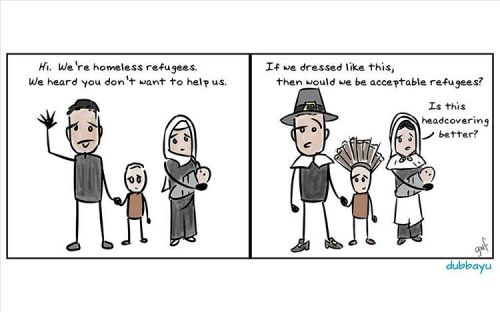
Pilgrims and Refugees

Thanksgiving - the moment we pause and remember that we were all once refugees - seeking asylum in an unknown place. What a powerful history we have of immigration. I think of this every time I look around my classroom - the diversity we experience in this country is incredible. So many roots - European, African, Asian, Middle Eastern, Latino. Five continents represented in my small, mid-west classroom. 
Because of this, I use Thanksgiving as a time for students to reflect on their own heritage through a family history project. This research continues after break and turns into our Christmas Around the World Study. You can read more about the Heritage project HERE. 
During reading, I love reading the beautiful and powerful How Long Till America. It is a great read aloud and really helps generate lots of discussion on immigration, beliefs, rights, and governments - all fifth grade social studies topics! Win. Win. Win! 
We watch the classic school house rock highlighting America as a "Great Melting Pot" and our great immigrant heritage: 

In addition, the day before break we do a little Thanksgiving celebration. Because we are in the middle of Native American studies, we do a Southwest American Indian craft - Sand Art! 
Students Sand Art Creations! 
In math, we use fractions and measuring to make cornbread - again referencing Native culture and the use of Maize as a diet staple. We also discuss the mixing of cultures when the Pilgrims came - hence the making of butter for our cornbread, something that could not have been done in North America prior to the arrival of European livestock. 
Student taking his turn "churning" our butter in a jar. 
And of course, what Thanksgiving celebration would be complete without the very American tradition of Charlie Brown??

Wednesday, June 29, 2016

Andrew Jackson's Face...

...is soon to be leaving our 20 dollar bills ... this was cause for cheers and celebration in my classroom earlier this school year. Prior to the announcement that Harriet Tubman, a minority AND a woman - GO AMERICA! was going to be replacing Old Hickory, we had studied the Trail of Tears.
As you know, the Trail of Tears marks one of the most controversial actions during Andrew Jackson's presidency - and an unfortunate study during any Native American Cultural unit. 
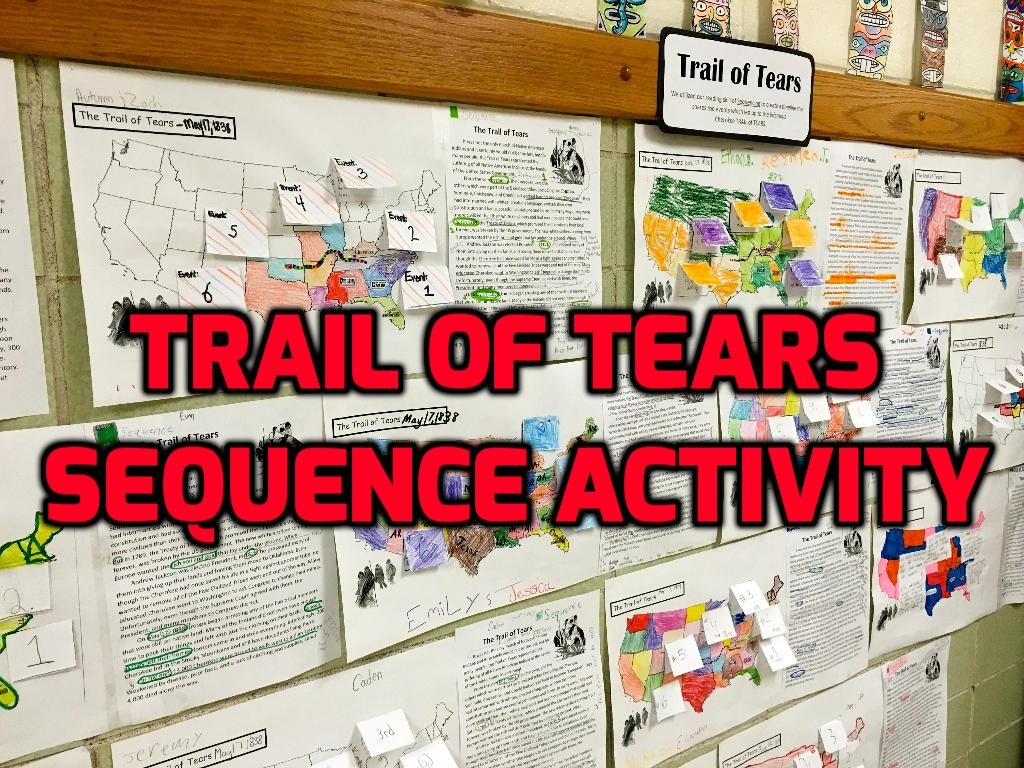
Blending both reading and social studies, I do a sequence activity summarizing the dreaded Western march of the Cherokee Indians. 
Together, we do a close reading of an article on the Trail of Tears, sharing our thinking in the margins and circling key sequencing words In the beginning, next, finally. 
Using this information, we number the the travel sequences (6) and students work in pairs to summarize each event on a slip of square paper. Students than recreate the journey on a map and place the sequenced events on it, in the order that they occurred. 
Students gain a lot of insight during this activity and come away from the experience with a lot of knowledge and empathy for the Cherokee people. 

Tuesday, June 7, 2016

Jimmy Cracked Corn

During our Early Settlements unit, the kids found all the different jobs that children had to do fascinating. Early on, students comments center around the children being over worked ..."treated like slaves, being worked too hard by their parents, the Cinderella story," etc ... However, as we dive deeper in to our study, I am always happy to discover the change in my student's understanding what up, Synthesizing!! :P
One important lesson that really helps drive this understanding home is a reading inference lesson on Sarah Morten's Day. I am sure many of your are familiar with this book, being a teacher favorite around Thanksgiving. 
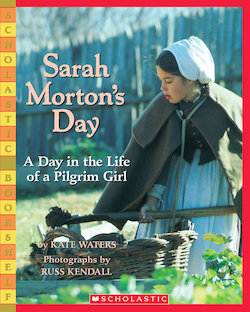
I start the lesson by reading the story as a good old fashioned read aloud. By this time, students have a pretty good understanding of Jamestown and Plymouth so they can make some good connections to the text. 
I then work through the inference sheet I have created modeling my thinking with the first text inference, the second two they complete by sharing their thinking with their partner and than writing down, the last two should be accomplished individually, however, you may need to model more if this is a new skill. 
At the end, students have an opportunity to share their reflection on what life was like for children during early settlements. After diving deeper into the text's meaning, students can form a more accurate assessment of childhood. 
Student Observations: 
  • They probably had to work harder because if they didn't their family might struggle for food during the winter. 
  • Everyone had to help out to help the family survive - pull their own weight.
  • They were very respectful of adults and their parents.
  • They enjoyed games like we do.
  • Parents had to be strict because life was harder and they were focused on survival.
  • Parents loved their children and children loved their parents, just like today.
As a fun sponge activity, we also practiced grinding corn. I had the students fill out a planning sheet before our activity which can be found at my TPT store. They REALLY enjoyed this activity. 
Materials Needed: 
Planning/Reflection sheet for each group
24 medium sized rocks 
One 10lb bag of squirrel corn (whole cob) 
Container to carry corn and corn meal 

Students had a great time pounding corn - many of them were surprised at how long it took to get down to corn meal. They also discovered many different methods that helped the process, such as grinding the kernels with the rock instead of slamming the rock down, keeping the kernels together to crush instead of spreading them out, etc. 

Overall, I think this activity, along with the inference lesson, really helped the kids recognized the importance of children's work in early settlements and the manual labor it took. 
Related Posts Plugin for WordPress, Blogger...